
Hellooooo!
After a protracted intermission, Zip A Bag is making a stunning return!

Marker Pouches!
 |
| Fabric: Jessica Jones' Time Warp barkcloth in Blue Sunburst by Cloud9 Fabrics. |


I am very happy to have at last come to this post. I cannot count the number of requests I've received for this marker pouch - not only the finished pouches in my Etsy store, but also the pattern, or even just the dimensions, so that you could make it without drafting the templates yourself.
But tracing out templates takes time, as does fine-tuning the various pieces and dimensions to make sure they truly match and line up. After all, the way I sew is primarily patternless, and even my original templates were random shapes cut out of a cereal box or a magazine, with notes scribbled on them to remind me which edges needed SA and which didn't, and how much to trim off the corners or edges so everything would lie smooth and flat. Finally, I was also constantly changing certain measurements as and when the children wanted a taller pouch, or a wider one. When you've made several iterations of the original template, it becomes a bit of a fog.
Then, when this Zip A Bag series first began, people asked me for the dimensions for the simpler pouches from our first few chapters, because they were planning sew-alongs and didn't care to draft their own patterns. And those requests spilled over into the later posts, where the bags and pouches were more complicated and involved. So I thought I'd collect ALL my templates and, at the end of the series, release them as a single downloadable pattern file that you could buy.
BUT!
I'd already promised you the free templates to this marker pouch from long before that, hadn't I? So of course I couldn't be horrible and go back on my word and sneak that in that pattern file that you'd have to purchase, right?
So - poof! here it is! Free, as promised.
Please be reminded that this pattern, as with ALL my tutorials and patterns, is only for personal use and for gifts. Please don't use these tutorial instructions or the templates, or both, to make pouches (or marker pouch patterns) to sell commercially.

I'm going to repost the pictorial instructions from that old Marker Pouch Tutorial here, for your convenience, along with new notes and tips. But first, let's talk about padding options, shall we?
Because you'll be folding the body of the Marker Pouch down a lot during its operation, it is pointless (and ugly) to make it in a stiff fabric (like oilcloth) or to stabilize it with some stiff iron-on or sew-in interfacing. It's a crush-fest waiting to happen, is what I'm trying to say.
Instead, we use padding. It's soft and puffy, and gives body to thin fabrics (like the ripstop nylon lining) and doesn't crumple or crease from all that folding and bending.
My first Marker Pouches featured a layer of high-loft batting. No reason, other than that I had a lots of it at home and had run out of foam and headliner. Since then, I've actually gone out to replenish my stock of Padding Alternatives. Here are some of them:

- High-loft batting - don't bother with anything thinner; alternatively, you can use several layers of the lower lofts.
- Regular foam - comes in different thicknesses and the green high-density version. Pick what you feel gives a suitable level of padding.
- Flex-foam - this is foam coated on both surfaces with a synthetic fabric, so it isn't sticky under the presser foot. Tends to be pricey - about $10 a yard (20" wide). See picture below for the Flex-Foam label.
- Headliner - this is what the ceilings of cars are lined with. It is a layer of foam with a plush flannel-like fabric on one surface (the other surface is the exposed foam). This is grey.
- Headliner, tan.
- Headliner, black.
This is a close-up of the surface of Flex-Foam. Because it is coated on both sides with that fabric, it's a wee bit stiffer (but only a bit) than headliner, which has only one fabric surface.


Here are the Flex-Foam and the three headliner fabrics stacked to show you their relative thickness - each is about 1/4" thick.
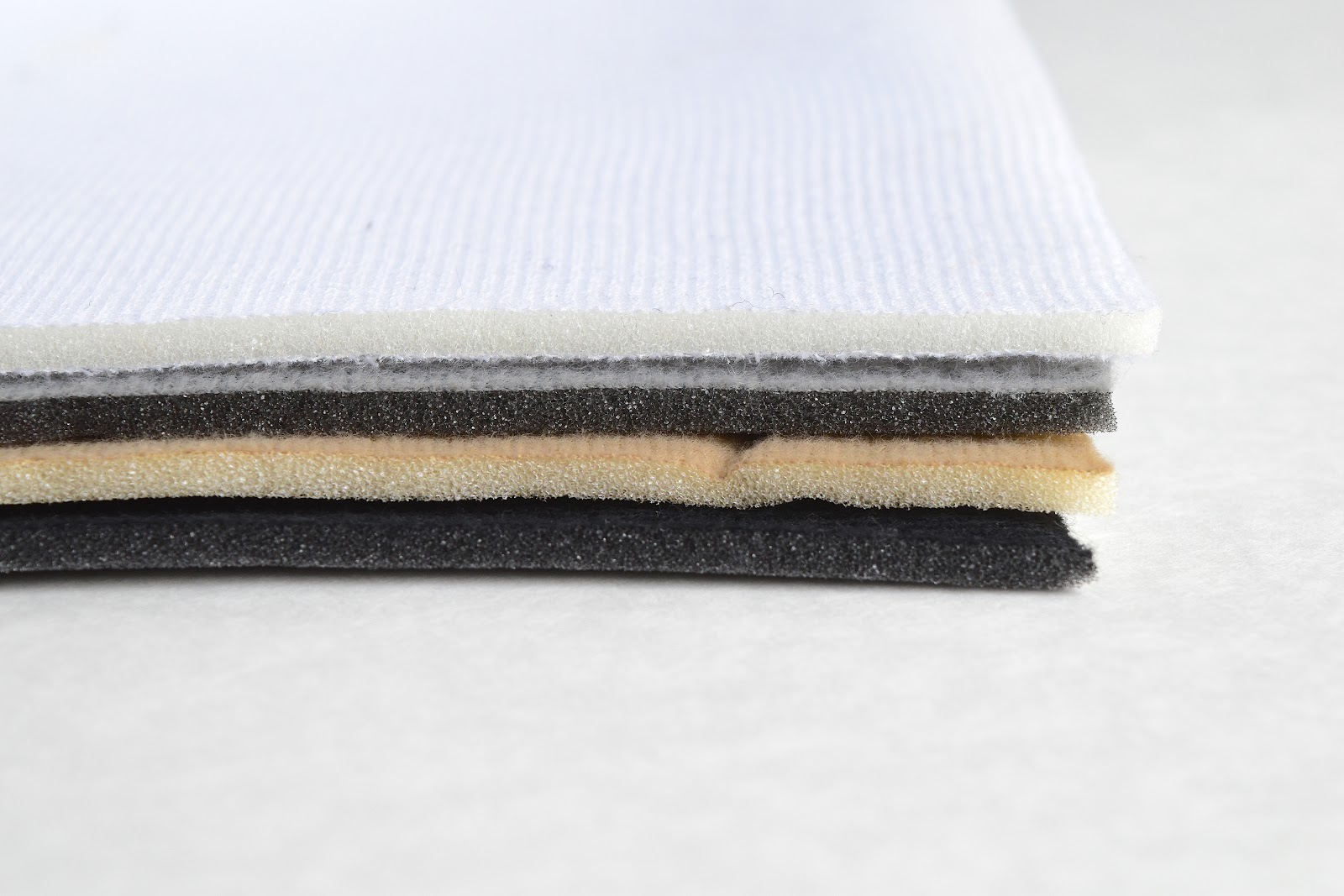
Let's make those marker pouches now.
Here's the construction sequence.
Here's the construction sequence.
Step 1 - Make the reinforced lining
Cut the main body with SA out of
- 1 x lining (I used ripstop nylon)
- 1 x padding
Baste these two layers together.
- Cut 1 x template plastic (buy from any quilting or fabric shop) according to the template, without SA.
- Cut 1 x piece of lining fabric to match the template plastic piece, with SA.

Sew the bottom edge and almost all the way up both sides of that smaller piece of lining to the bottom half of the batting-lining sandwich. It will be a pocket for the template plastic. Slide the template plastic into the pocket,

fold down that top edge of the pocket and tuck it behind the top edge of the template plastic.
Here's a tip: I trim my template plastic piece even further (e.g. I take off another 1/8" on all sides) to be sure it doesn't crowd the inside of the fabric pocket. When you fold the marker pouch body in half later, this piece of plastic is going to creep outward and encroach on your side SA. It may even pucker and refuse to lie flat inside its pocket. So trim as much as you need to.
Edge-stitch through all layrs to close the pocket, completely enclosing the template plastic. I sewed through the template plastic as well. It won't be the first time you might do it in this project. Just remember to change your needle when you're ready for your next project, especially if it's a chiffon skirt or something important.

This is the finished lining. The side that has the pocket is the RS. The side that has the padding is the WS.

Step 2 - Choose the nice fancy outer fabric
Please choose home-dec weight or canvas or something of that robustness. If you insist on quilting cotton, please reinforce it with a thicker piece of fabric.
NOT sew-in interfacing, because it will crumple with all that unzipping-and-folding-down-to-access-the-markers.
And especially NOT fusible interfacing because it doubly will crumple with all that unzipping-and-folding-down-to-access-the-markers.
NOT sew-in interfacing, because it will crumple with all that unzipping-and-folding-down-to-access-the-markers.
And especially NOT fusible interfacing because it doubly will crumple with all that unzipping-and-folding-down-to-access-the-markers.
Okay, so... summary:
Cut 1 x body in the outer fabric as lining, with SA.
You can also go ahead and trim the surplus padding now.

Step 3 -Attach the zipper to the lining
This part is easier than it looks, okay? My best tip to make it as easy as possible is to use a separating zipper. But if you can't find one, just use a zipper that's long- at least 3" longer than the zippered opening itself.
Follow the photo annotations and zipper orientation below. Leave a central 1" (ish) section at the top of the lining without any zipper tape. Also don't sew on the actual stitching line, because you are going to do that in the next step. Just baste within the SA so these stitches can be hidden later.

Zip up the pouch to check that the zipper is correctly installed. By "correctly", I mean that when zipped up, the padding side should face out, as shown. This is the surface that will be covered by the fancy outer fabric. You want the lining fabric to be inside the pouch.

Also check that the tail end of the zipper freely extends out of the pouch and toward the back. In other words, the pouch should look just like the finished version, except it now has just the uncovered padding instead of the actual outer fabric.

Step 4 - Add the outer fabric
Here's a zoomed-in photo of that 1" section. Separate the zipper and cross the ends. Pin them in place. This will greatly reduce the Fiddly Zipper Factor in the next step.

Now add the outer fabric to the lining, with their RS touching and the zipper sandwiched between them. Sew all around on the actual stitching line (hiding the earlier basting stitches, remember?), except for MOST of the bottom edge, which should be left open for turning out.

Turn the whole thing RS out, clip/notch/grade/press whatever you need to (yes, you can press ripstop nylon on the appropriate iron setting), tuck the SA of that big opening in, and edge-stitch all around the entire pouch to reinforce and flatten the seam, closing the big gap in the process.
At the end of this step, you should have a neat, padded placemat-looking thing with all its SA tucked away, and which zips up to look just like the finished thing.
At the end of this step, you should have a neat, padded placemat-looking thing with all its SA tucked away, and which zips up to look just like the finished thing.
Step 5- Sew the base and front wall
This is made entirely out of lining fabric which, in this case, is again ripstop nylon. Cut it in this tongue shape. Bind the entire perimeter. I use a thick grosgrain trim. You can use bias tape or fully line the entire base/wall so it's a double-layered shape with all the SA tucked inside.

Step 6 - Attach base/wall to pouch
Up till this point, the pouch is still completely flat, like (as earlier said) a padded placemat. Just attach the base/wall to the bottom half of the pouch and it will become a 3D thing. It's not a difficult step, sewing-wise, especially if you are used to sewing 3D structures. Some tips:
- Sew with the base/wall on top and the padded body below, under your presser foot, not the other way around. In other words, the spool thread goes on the base/wall and the bobbin thread goes on the outside of the pouch. If you're leery of ugly stitches, use invisible thread in the bobbin.
- Mark mid-points and check centralizing while sewing. Don't pin if you can help it. Sometimes you need the fabrics to flow as you ease the layers together, and pinning introduces premature rigidity in the alignment of those fabrics. Which results in puckers or crooked stitching.

It was hard to get a good shot of how that base/wall piece joined to the zippered sides and turned the bottom corners of the pouch. Here's a frontal shot.

And here's a high-contrast shot with the yellow zipper and that corner.

Here's the finished pouch, zipped up to show how that base folds in on itself.

Step 7 - Finish the tail of the zipper
Self-explanatory: use whatever method and material you are used to, to finish that tail. I used a folded leather or vinyl sandwich because it was fast and easy.

- I found it easier to install this zipper tab just after Step 4 instead of at the end. Attaching it while the pouch was still flat and unfolded (i.e. before we attached the base) was a lot less fiddly under the machine arm.
- Don't be discouraged if you don't find this pouch as easy to make as it might appear, okay? While I wouldn't for a moment consider it difficult (you can make one in a day or less), I'll be honest: it nonetheless IS fiddly. I mean, it's a 3D structure that has a lot of curves in places that are inconvenient, and it's stiff in other places that make it unwieldy to handle. And it has a zipper which, for some people, translates to Ew, Let's Just Give Up Now. I also know that some of you have been waiting for these templates so you can mass-produce them for all your kids' friends, classmates and neighbors. Bravo - mass-producing rocks. However, I'd suggest you try ONE marker pouch before committing to making a hundred. Just thought I'd set the appropriate expectations, in the hope that it will help you guys persevere if you hit a snag or two. You can do it! Many of us have already done it, and are sharing testimonies of how they're still alive after. So don't give up! I think you'll love the outcome.
- Vinyl and leather are equally easy to sew. You will need a leather needle (go Google that), NOT a topstitching needle, even though you may be using topstitching thread (aka heavy-duty thread). Vinyl and leather are "sticky" fabrics and the leather needle's shaft has a slightly flattened tip that helps it pierce through without the stitches skipping. That said, some leathers are easier to sew than others. I've had some trouble with very dense, stiff suede, for instance, but the softer, shiny leathers are lovely and fuss-free.
I hope some of these tips help you - enjoy making!


